
Trading Journal Foundations
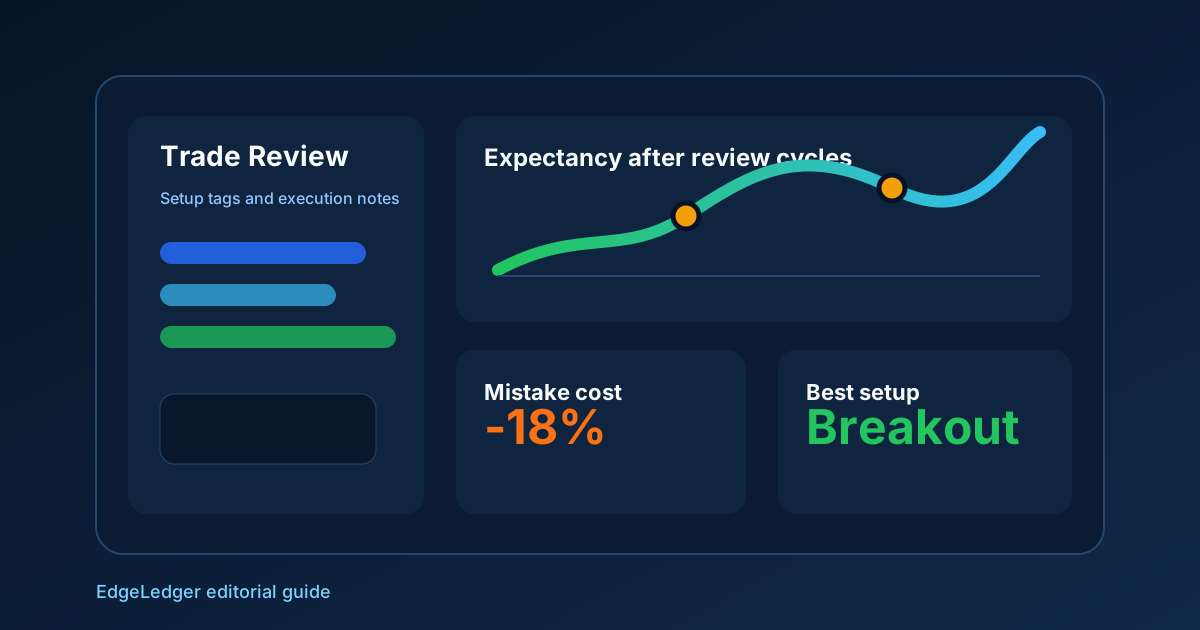
Core guides for building a review process, tagging trades and measuring actual performance quality.
EdgeLedger guides
Practical articles for traders comparing journal tools, improving review habits, connecting exchanges and MetaTrader, tracking prop firm rules, using AI insights and preparing tax-oriented exports.
Topic clusters
Core guides for building a review process, tagging trades and measuring actual performance quality.
Challenge rules, drawdown monitoring, journal requirements and funded-account decision support.
How EdgeLedger connects exchanges and MetaTrader, surfaces AI insights and prepares cleaner reports.
Head-to-head guides for traders comparing journals, exchanges, prop firms and manual versus automated workflows.
Latest articles
FundedNext publishes one of the longest prohibited-strategy lists in the industry — and most "payout denied" stories trace to one of its specific clauses. Here’s the list in plain trader language, verified June 2026.

TradeZella is a genuinely good journal — and for funded prop traders it still leaves gaps: real-time rule protection, payout pre-flight, and a free tier that isn’t crippled. Here’s a fair comparison, as of June 2026.

The UK Section 104 pooling rule is one of the most painful crypto tax calculations to do manually. Here's how the pool works, why share-matching rules trip up most traders, and how to generate an HMRC-friendly schedule without ever opening Excel.
A denied or delayed payout usually traces back to a specific clause — not bad luck. The practical sequence: identify the exact rule, assemble your evidence, escalate properly, and pre-flight the next request.
Myfxbook has been the default forex analytics community since 2009. It still works — but the UI is dated, the AI features are absent, and it doesn't touch crypto or prop firms. Here's what fills the gap.
Most traders don’t have a strategy problem on trades 1–3. The bleeding starts later in the session. Here’s how to find YOUR cutoff number from your own data, and how to make it stick.
There's a measurable pattern behind tilt: 3 consecutive losses dramatically increase the probability your next trade is impulsive. Here's the data, the psychology, and the system that interrupts the loop.
Tilt doesn’t feel like recklessness from the inside — it feels like conviction. Here’s how a single tilt session compounds, a worked example of the math, and the early signals you can actually act on.
Most MT5 journals rely on statement file uploads — slow, manual, and always behind. The Expert Advisor bridge changes that. Here's how it streams every fill into your journal in seconds.
Revenge trading isn’t a knowledge problem — you already know you shouldn’t. It’s a state problem. Here’s the mechanism, the math of what it costs, and the only fixes that survive contact with a losing day.
Stop copy-pasting Bybit trades into spreadsheets. Here's the 5-minute setup to auto-sync every fill into a real journal with full analytics, fee accounting, and FIFO position matching.
Willpower fails under pressure. Commitment devices don’t. Here’s how to turn your trading rules — written in a calm state — into something that actually intervenes when you’re about to break them.
Most blown accounts aren’t a strategy problem — they’re a behaviour problem. Here’s why knowing your rules isn’t enough, and how to measure what your indiscipline actually costs you in dollars.
Side-by-side breakdown of Tradezella and EdgeLedger for crypto and prop firm traders — features, pricing, integrations, and which one actually fits your workflow.
Most Hola Prime traders fail in the first 72 hours because they miscalculate trailing daily drawdown. Here's the exact math, the common mistakes, and the discipline rules that get traders to the funded phase.
A no-fluff comparison of every tool serious crypto prop firm traders use to track Hola Prime, FundedNext Crypto, and CFT challenges — and why most of them miss the one feature that actually matters.
Win rate is the most misunderstood metric in retail trading. A trader with a 35% win rate can consistently outperform one with a 70% win rate — and the reason is expectancy.
Crypto markets move through four distinct phases. Understanding which phase you are in changes which strategies work, which setups fire most often, and how aggressively you should trade.
Leverage is the fastest way to build and destroy a trading account. Understanding exactly how it works — and the correct way to use it — is non-negotiable for futures traders.
Losing streaks are inevitable in trading. The difference between traders who survive them and those who blow their accounts is entirely about response protocol.
Discipline in trading is not a personality trait — it is a collection of daily habits. Here are the seven most impactful ones for protecting your account and improving consistency.
A trading plan is not a wish list — it is a decision engine that removes in-the-moment choices from the equation. Here is how to build one that you will actually follow.
The uncomfortable statistics about retail trading and the five behavioural patterns that consistently separate profitable traders from the majority who eventually quit.
EdgeLedger Bridge is the MetaTrader plugin that automatically syncs your forex, CFD, and futures trades to EdgeLedger. Here is the complete setup guide from installation to first sync.
Choosing the wrong prop firm costs you evaluation fees and months of time. Here's a detailed comparison of FTMO, The5ers, and E8 Funding for forex traders, including rules, fees, and payout structures.
Standard trading journals weren't designed for prop firm rules. Funded traders need daily drawdown monitoring, real-time equity tracking, and rule-breach alerts. Here's what to look for.
Most prop firm challenge failures are preventable. Here's how top-funded traders use trading journals to track drawdown limits, avoid rule breaches, and pass evaluation phases on the first attempt.
Whether you trade on Bybit, OKX, Kraken, or multiple exchanges at once, here's how to sync all your trades into one place and get cross-exchange performance analytics.
Manually logging Binance trades is error-prone and slow. Learn how to connect your Binance API to auto-sync every trade and use your data to find the setups that actually make you money.
Stock traders face unique journaling challenges: earnings events, sector rotation, options overlays, and pre/post-market action. Here's a complete guide to tracking what actually matters.
A forex trading journal is your most important edge-building tool. Learn exactly what data to log, how to review weekly, and which metrics separate profitable forex traders from losing ones.
We tested every major trade journal platform head-to-head. Here's an honest breakdown of pricing, features, exchange integrations, and which one actually makes you a better trader.
EdgeLedger's AI analyzes your full trade history to find patterns you'd never spot manually. Here's what it looks for and how to turn each insight into a rule.
Chasing a 70% win rate with a bad risk-reward destroys accounts. Here's how to set mathematically sound win rate targets based on your strategy's actual R-multiple profile.
Most traders lose money for the same five reasons, repeated endlessly. Here's what journal data from thousands of traders reveals about the most costly behavioral mistakes.
Unrealized gains feel real until they aren't. Learn the critical difference between realized and unrealized PnL, and why mixing them up destroys trader psychology.
Both markets offer volatility and opportunity, but they differ in sessions, leverage, regulation, and the type of edge that persists over time. Here's an honest comparison.

You don't need Python or QuantConnect to backtest a strategy. Learn how to validate your edge using your own historical trades and simple rules.
Manually logging trades builds discipline — but it's slow and error-prone. Automated sync is effortless but removes a friction layer that some traders rely on. We settle the debate.
New to crypto and choosing your first exchange? We compare the three most beginner-friendly platforms on fees, safety, supported assets, and ease of use.
Trendlines are the oldest technical tool in trading — and still one of the most reliable. Learn a rules-based framework for drawing, validating, and trading them.
Futures offer leverage and short-selling but carry liquidation risk. Spot is simpler but caps your upside. Here's how to choose based on your experience level.
When crypto trends sideways, most strategies struggle. Grid trading thrives in range-bound conditions by buying dips and selling bounces automatically.
Swing trading captures multi-day crypto moves without the stress of intraday watching. Learn the setup criteria, position management, and ideal pairs for this strategy.
Scalping requires fast execution, tight risk, and a statistical edge. Here's a structured 5-minute chart scalping framework that professional traders actually use.
Isolation is the enemy of trading discipline. Learn how EdgeLedger's Accountability Partner feature creates external accountability that improves consistency.
When a whale moves 10,000 BTC to an exchange, the market often reacts within hours. Learn to interpret whale alerts and separate signal from noise.
A bare trade log gives you P&L. A tagged, annotated journal gives you edge. Learn the exact tagging system top traders use to extract maximum insight from every trade.
EdgeLedger
Start free with manual journaling, then upgrade for exchange sync, MT4/MT5 bridge support, AI insights, prop firm tools and tax exports.