The EdgeLedger AI Insights Feature: What It Detects and How to Act on It
EdgeLedger's AI analyzes your full trade history to find patterns you'd never spot manually. Here's what it looks for and how to turn each insight into a rule.
Why You Need AI-Assisted Pattern Detection
The human brain is poor at finding statistical patterns in noisy data — it sees patterns everywhere, including random noise. AI-assisted analysis cuts through that noise to surface only patterns that are statistically significant across your actual trade history. It doesn't tell you what to do; it tells you what your data says about what you've already done.
What EdgeLedger AI Looks For
Session-Based Biases
The AI segments your trades by UTC hour and calculates win rate, average P&L, and profit factor for each hour. Traders are often stunned to discover they're profitable from 09:00–15:00 UTC and lose money outside those hours. This single insight — "only trade during your profitable session" — can transform a losing trader into a profitable one without changing the strategy at all.
Setup-Specific Edge
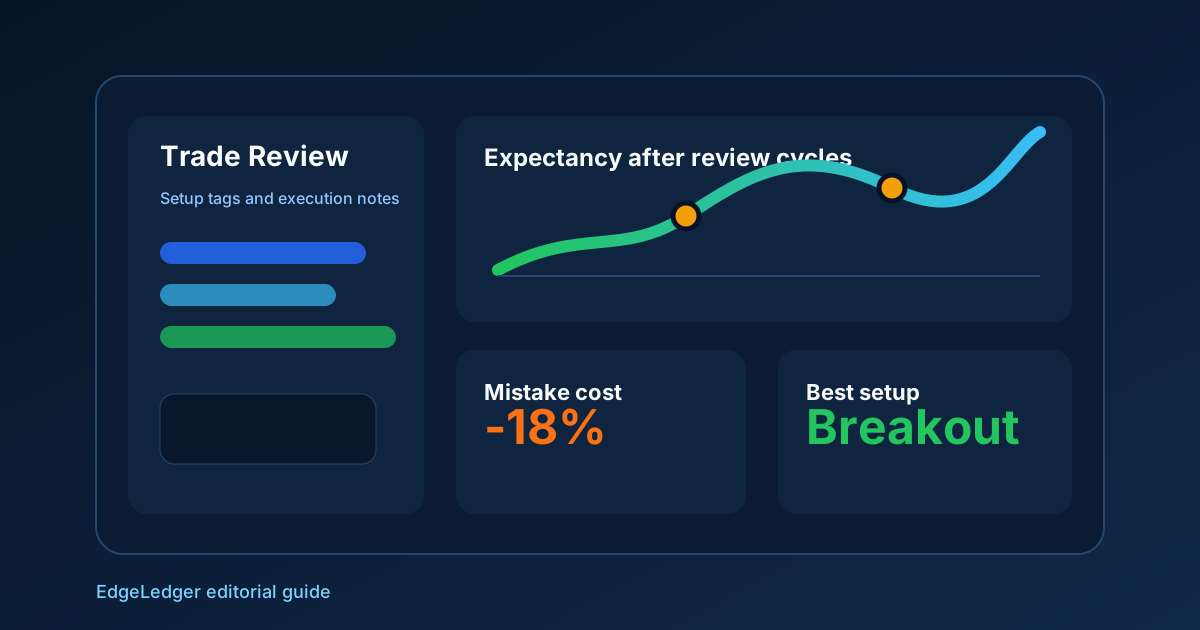
By comparing tagged setup types, the AI identifies which setups have statistically significant positive expectancy versus which are noise. If you have 50+ breakout trades and 50+ mean-reversion trades, the AI can tell you with confidence which setup type generates your actual edge.
Pair and Asset Performance
Many traders have positive P&L on BTC and ETH but systematically lose on altcoins — or vice versa. The AI segments performance by asset and flags pairs where your edge is negative, enabling you to make a data-backed decision to drop those pairs from your plan.
Behavioral Risk Flags
The AI monitors for:
- Increasing position sizes after losses (tilt precursor)
- Holding losers longer than your historical average
- Trading frequency spikes correlated with drawdown periods
- Win rate degradation on specific days of the week
Turning Insights into Rules
Every AI insight should map to a specific, testable rule. "You lose money after 20:00 UTC" → Rule: no trades after 20:00 UTC. "Your breakout trades outperform mean-reversion 3:1 on risk-adjusted basis" → Rule: reduce mean-reversion frequency, increase focus on breakout setups. The power is in the action, not just the observation.
Accessing AI Insights in EdgeLedger
Navigate to Analytics → AI Insights in your EdgeLedger dashboard. The analysis runs automatically on your full trade history and refreshes weekly. New insights are flagged and delivered as notifications — you don't need to go hunting for them. The more trades you log, the richer and more accurate your insights become.
When to Recheck Insights
Insights are point-in-time snapshots of what your trade history suggests. They are not perpetual truths. A trader whose session-bias insight pointed to London open productivity in Q1 may find that bias has reversed in Q2 as the trader's strategy mix shifted or market conditions changed. Schedule a quarterly review of every AI-flagged rule to confirm it still holds against fresh data. Rules that no longer reflect the data should be retired rather than left to confuse the playbook.
False Positives
Statistical analysis on noisy data produces some inevitable false positives. A 50-trade sample might appear to show a strong day-of-week effect that completely disappears when the sample reaches 200. The AI surfaces directional flags below the strong-confidence threshold and clearly marks them. The right response to a low-confidence flag is to monitor it for the next month, not to immediately rewrite the playbook around it. High-confidence flags backed by 200+ observations are different — those are findings, not hypotheses.
Compounding Rules Across Insights
The biggest expectancy improvements often come from combining two insights into one compound rule. If the AI says you are most profitable in the London session and that you have positive edge on breakout setups but not mean-reversion setups, the compound rule is "trade only breakouts during London session." The combined filter typically removes 60–80 percent of trades and improves the remaining set's profit factor by a multiple. The trade-off is fewer trades and longer waits — which most traders find harder than they expected.
Sharing Insights With a Mentor
An insight read in isolation can be misinterpreted as "your strategy is broken" when the real message is more nuanced. Sharing the insight report alongside the underlying data with a coach or mentor accelerates the right interpretation. EdgeLedger's mentor access feature scopes a read-only view to the analytics dashboard so the mentor can see the same insights without seeing balances or unrelated activity. The structured handoff turns a one-way data report into a productive coaching conversation.