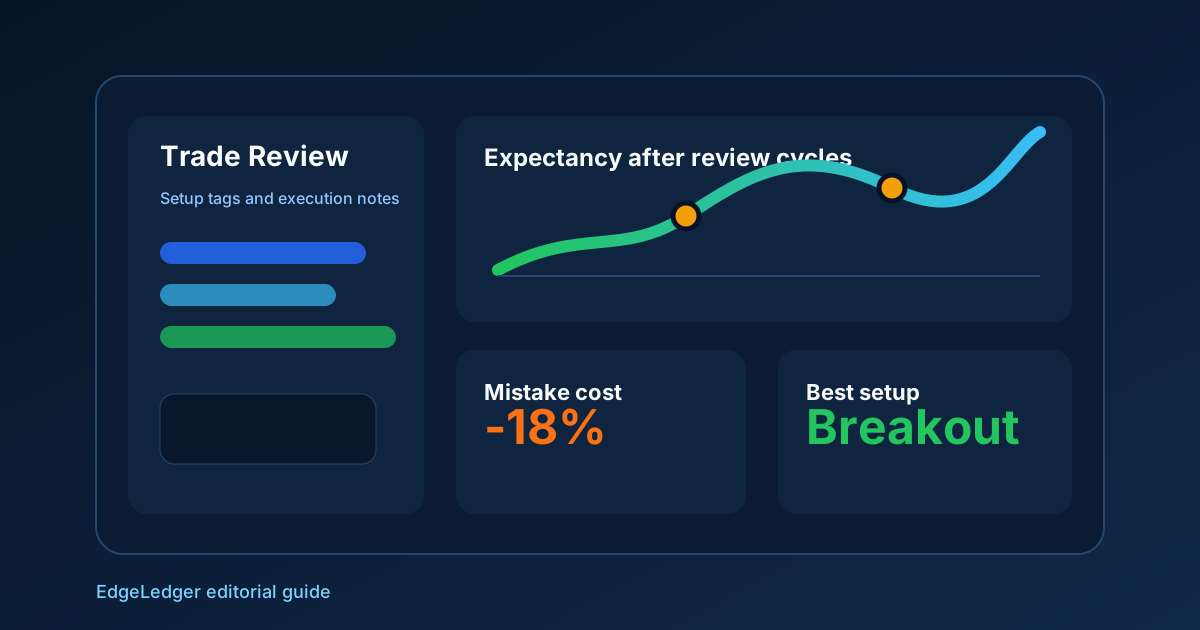
How to Backtest Your Crypto Trading Strategy Without Writing Code
You don't need Python or QuantConnect to backtest a strategy. Learn how to validate your edge using your own historical trades and simple rules.

The Backtesting Misconception
Most traders think backtesting requires coding complex algorithms in Python or using specialized platforms. But the most valuable backtest you can run uses your own trading data — because it accounts for your execution, your psychology, and your specific market conditions.
The Forward-Looking Journal Backtest
Here's the approach: instead of simulating hypothetical trades, you analyze your real trades to test what would have happened if you'd followed stricter rules.
Step-by-Step Process
- Step 1: Export or filter your trades by a specific setup type (e.g., "breakout" or "support bounce").
- Step 2: For each trade, check if it met your ideal entry criteria. Was volume above average? Was the higher time frame aligned?
- Step 3: Separate trades into "met all criteria" vs. "took it anyway." Compare win rates and average P&L.
- Step 4: Calculate the expectancy of the filtered subset: (Win% × Avg Win) − (Loss% × Avg Loss).
What You'll Discover
Almost every trader who does this exercise finds that their filtered subset (trades that met all criteria) significantly outperforms the unfiltered set. This proves that your strategy has edge — you just need more discipline in execution.
Automating This with EdgeLedger
EdgeLedger's Strategy Test feature does exactly this. Tag your trades with setup types, filter by any combination of criteria, and instantly see expectancy, win rate, and equity curves for each subset. It's backtesting against your own real performance — no code needed.
Beyond Simple Filtering
Try segmenting by time of day, day of week, market regime (trending vs. ranging), or even your self-rated emotional state. The more dimensions you test, the more granular your edge becomes. Some traders discover they're profitable in Asian session but lose money during US hours — insights that only come from structured data.
Data Hygiene Before Backtesting
Backtests against bad data produce worse decisions than no backtest at all. Before running any analysis against your own trade history, audit three things: are all the fees included (especially funding rates on perpetual trades), are partial fills consolidated correctly into single positions, and are the entry and exit timestamps accurate enough for the timeframe you are analysing? EdgeLedger's import pipeline handles these for supported exchanges, but always sanity-check a sample of trades against the exchange's own statement before you start drawing conclusions.
Sample Size and Confidence Intervals
Twenty trades is a story. Two hundred is a hypothesis. A thousand is a finding. Sample size dictates how much weight you can put on the result. A simple rule of thumb: for any subset you filter (e.g., "breakout trades during London session"), require at least thirty observations in the subset before treating the result as anything more than directional. If your "best setup" has only twelve trades behind it, the right action is to keep taking those trades and re-evaluate at thirty.
Walk-Forward Validation
Backtesting your full history will overfit your conclusions to the past. Walk-forward validation splits the data: optimise rules on the first two-thirds of your trades, then test the optimised rules on the most recent third. If the optimised rules outperform on the held-out set, the edge is real. If they only outperform on the optimisation set, the edge was a coincidence of the data.
Regime Detection
The same strategy that prints money in a trending market may bleed in chop. Tag every trade with the prevailing regime — trending, ranging, high volatility, news-driven — and segment your backtest accordingly. The most useful insight from this kind of analysis is rarely "my strategy works" or "my strategy fails." It is "my strategy works in regimes A and B and loses in regime C," which gives you a regime filter to disable the system in conditions where it is structurally a poor fit.