Why Disciplined Traders Still Give Back Their Gains
Most blown accounts aren’t a strategy problem — they’re a behaviour problem. Here’s why knowing your rules isn’t enough, and how to measure what your indiscipline actually costs you in dollars.

Ask a hundred traders why they lost money and most will point at a setup, an indicator, or a bad fill. Yet study after study of retail performance lands on the same uncomfortable conclusion: the dominant cause of failure isn’t analytical, it’s behavioural. Traders break rules they already know — and they do it most when it matters most.
Knowing the rule is not the same as following it
You can recite your max risk per trade, your daily stop, your "no trading after two losses" rule — and still override every one of them at 2pm when a position is running against you. There’s even a physiological version of this: as an account moves into a deeper drawdown, decision-making measurably degrades as the brain shifts from analytical mode toward a stress-driven, survival mode. The plan you wrote in a calm state isn’t the brain making the decision under fire.
The four patterns that quietly drain accounts
- Revenge trading — re-entering minutes after a loss, trying to "win it back". Win rates in that window are usually far below baseline.
- Over-trading — the 4th, 5th, 6th trade of a session, long after your edge for the day was spent.
- Sizing up — quietly increasing position size after a good run, so one outsized trade undoes weeks of discipline.
- Breaking the plan — taking setups that don’t match anything you’d pre-defined.
The journal paradox
The standard advice is "keep a journal". But here’s the catch most people don’t mention: the traders most likely to abandon their journal are the ones who just became profitable — and they’re precisely the ones most likely to drift and give the gains back. A journal that gets abandoned right when it matters isn’t a safety net.
Price the leak, don’t just log it
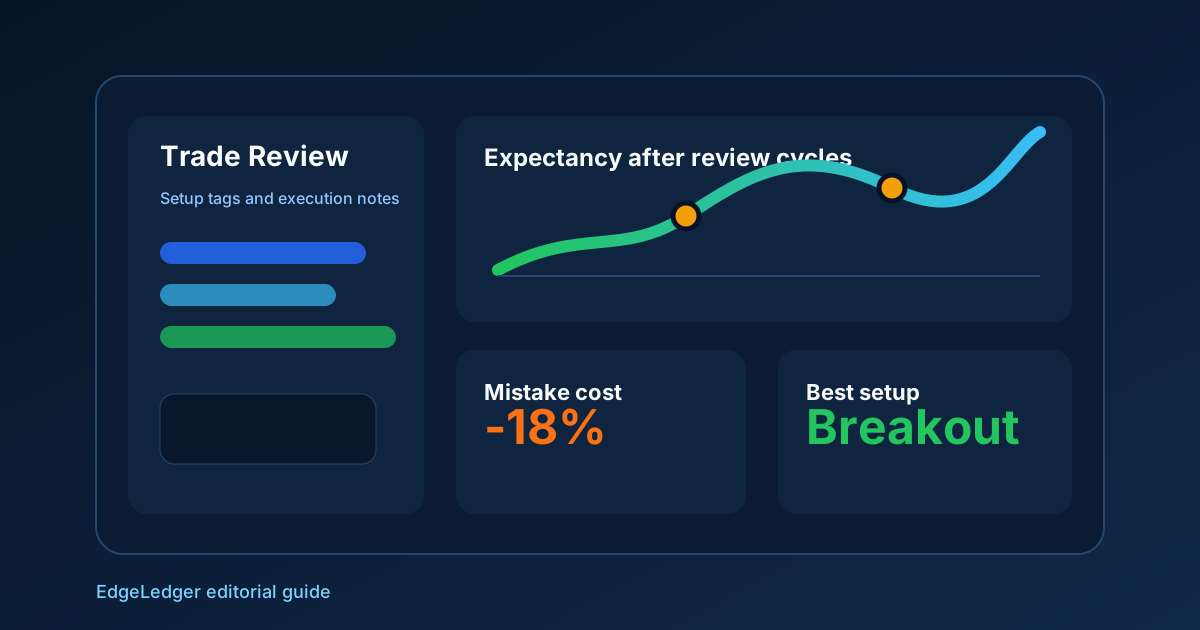
What actually changes behaviour is seeing the cost in dollars. Not "you sometimes revenge trade" but "trades you opened within 30 minutes of a loss cost you $1,400 over the last 90 days, at a 28% win rate versus your 51% baseline." That number is uncomfortable enough to act on.
That’s exactly what EdgeLedger’s Discipline Report does: it replays your own closed trades, isolates each failure pattern, and prices it — with an honest "not enough data yet" when your sample is too small to be meaningful. No fabricated scores, just your record.
The point isn’t guilt — it’s a forcing function
Measuring the leak is step one. Step two is putting something between you and the 2pm version of yourself. We’ll cover that in the next piece: turning your rules into a contract your future self can’t quietly ignore.