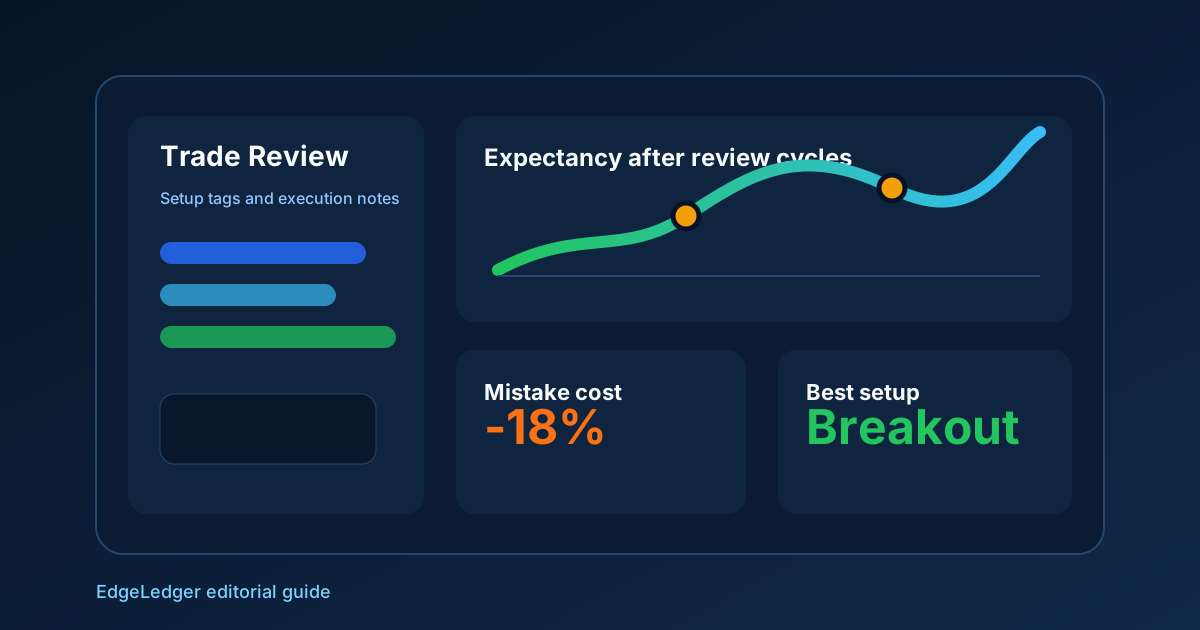
How to Use Tags, Notes & Setup Labels to Get 10× More from Your Trading Journal
A bare trade log gives you P&L. A tagged, annotated journal gives you edge. Learn the exact tagging system top traders use to extract maximum insight from every trade.
Why Most Journals Don't Help
Most traders log the bare minimum: entry price, exit price, P&L. Then they wonder why they keep making the same mistakes. Without structure, a journal is just a ledger. With structure, it becomes a performance database that answers questions like: "What is my win rate on breakout setups during Asian session?" or "Do I perform better on Mondays or Fridays?"
The Four-Layer Tagging System
Layer 1: Setup Type
Tag every trade with the type of setup that triggered it. Keep this list short and consistent — 5–8 setup types is ideal. Examples:
- Breakout, Mean-Reversion, Support-Bounce, Trend-Continuation, News-Reaction, Range-Fade, DCA-Level
Layer 2: Market Condition
Was the broader market trending, ranging, or in a news-driven event at the time? Tag accordingly: Trending, Ranging, High-Volatility, Low-Volume.
Layer 3: Execution Quality
Rate your execution from 1–5 independently of the outcome. A 1 = impulse trade that violated your rules. A 5 = textbook execution of your plan. This separates luck from skill in your review process.
Layer 4: Emotional State
A single tag captures your state at entry: Calm, Uncertain, FOMO, Revenge, Overconfident. After 50 trades you'll almost certainly find that trades tagged "FOMO" or "Revenge" have significantly worse outcomes than trades tagged "Calm."
Using Notes Effectively
Keep trade notes short and forward-looking. Instead of writing "price went up and I sold," write: "Breakout entry at $48,200. Volume was 3× average. Higher TF is bullish. Target: $51,000. If we break below $47,800 before reaching target, setup is invalidated." Then compare notes to outcome during your weekly review.
Automating the Review
EdgeLedger lets you filter your entire trade history by any combination of tags. Create a filter for "Setup=Breakout AND Execution≥4" and compare that profit factor to "Setup=Breakout AND Execution≤2." Most traders are stunned to find their edge vanishes when execution quality is low — their strategy works, but their discipline is the bottleneck.
Designing the Tag Taxonomy
Most journal tag schemes fail not because the tags are wrong, but because there are too many of them. A taxonomy with thirty setup types is unusable — every trade requires a debate before it can be filed. Aim for between five and eight setup tags, five condition tags, three or four emotional state tags, and execution quality on a 1–5 scale. Total: under twenty tags. If you find yourself wanting more, the marginal value of each additional tag falls quickly.
Common Tagging Mistakes
- Outcome-based tags — labelling a trade "good trade" or "bad trade" after the fact contaminates the analysis. Tag inputs, not outputs. Outcome is what the analysis measures.
- Synonym sprawl — "breakout" and "break-out" and "BO" all referring to the same setup. Standardise the list and stick to it.
- Mid-week additions — never add a new tag during an active trading session. Add the tag during the weekly review, then apply it consistently going forward.
Quarterly Tag Reviews
Once per quarter, review every tag's usage and outcome data. Tags that have fewer than ten trades attached after three months are probably either too narrow or never relevant — consolidate or drop them. Tags that are used heavily but show no statistically meaningful difference in outcomes are not adding signal — drop them too. The goal is a tag set that explains your performance, not one that catalogues everything you could think of.
Evolving the Tag Set
As your trading matures, the tag set should mature with it. New traders need broad setup categories. Experienced traders eventually want sub-categories — "breakout from triangle" versus "breakout from horizontal range" — because the granularity reveals edge that the broader category hid. Let the tag set grow only when the data demands it, not because you read an article about a new framework.