How to Build a Crypto Trading Journal That Actually Improves Your Win Rate
Most traders lose money because they repeat mistakes they never tracked. Learn how to build a structured trading journal that turns raw data into actionable edge.

Why 90% of Traders Fail — And How a Journal Fixes It
The most common reason traders blow accounts isn't bad strategy — it's repeating the same mistakes without realizing it. A trading journal creates a feedback loop that turns every trade, win or loss, into a data point you can learn from.
What to Log in Every Trade
A useful journal goes far beyond entry and exit price. Here's what elite traders track:
- Setup type — What pattern or signal triggered the trade?
- Risk-to-reward ratio — Was the potential profit worth the risk?
- Emotional state — Were you calm, anxious, or revenge-trading?
- Market context — Trending, ranging, or high-volatility environment?
- Screenshots — Chart snapshots at entry and exit tell the full story.
From Raw Data to Edge
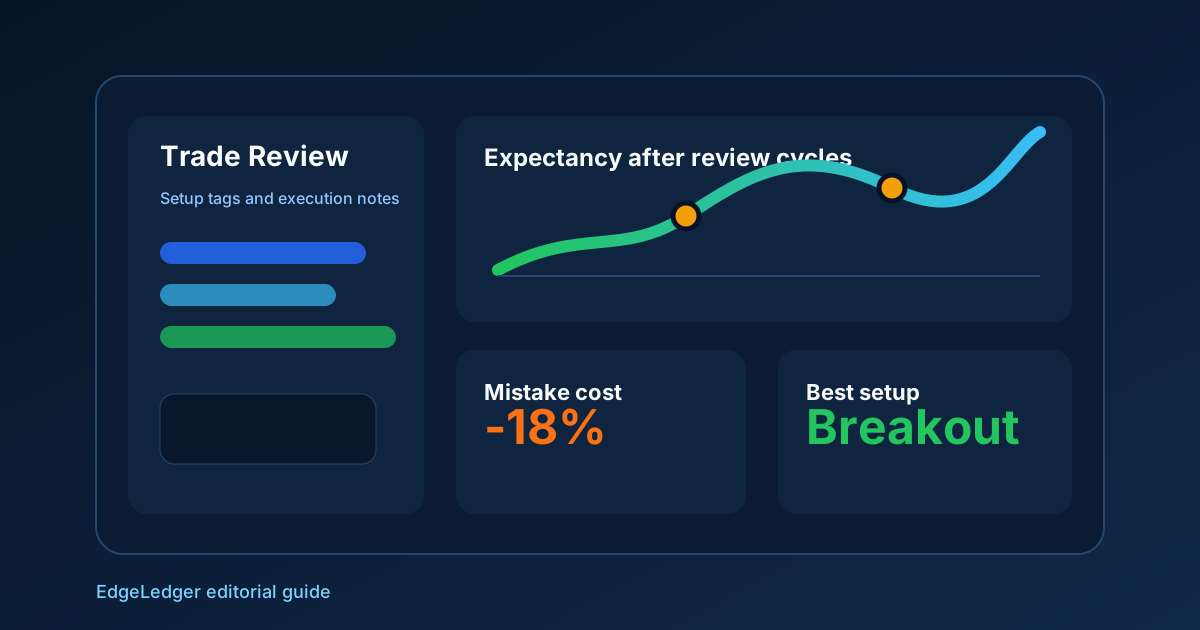
After 50+ logged trades, patterns emerge. You'll discover which setups have the highest expectancy, which time frames suit your style, and which emotional states lead to impulsive decisions. This is where journaling transforms from bookkeeping into a genuine competitive advantage.
The Review Cycle
Set a weekly review session. Open your journal, filter by losing trades, and ask: "Would I take this trade again with the same information?" If the answer is no, you've found a leak to plug. If yes, the loss was simply variance — move on.
Digital vs. Spreadsheet vs. Dedicated Tools
Spreadsheets work but don't scale. Dedicated tools like EdgeLedger automate P&L calculations, sync exchange data, and surface analytics that would take hours to compute manually. The best journal is the one you'll actually use consistently.
Getting Started Today
Start with your last 10 trades. Log them retroactively, tag each with a setup type, and rate your execution from 1–5. Within a week, you'll spot at least one pattern you didn't know existed.
The Weekly Review Structure That Works
A journal that never gets reviewed is a database, not an edge tool. The review session is where journaling actually produces compounding returns. The structure that survives contact with a busy week is short and ritualised:
- Open the equity curve first. Look at the shape over the last seven days. Was it smooth, choppy, or marked by one or two outsized trades?
- Filter to losing trades only. For each loss, ask whether the entry obeyed your rules and whether the stop hit at your defined invalidation. If both are yes, the loss was variance. If either is no, it is a rule violation.
- Identify your single biggest leak. Pick one thing — overtrading on Wednesdays, taking trades during the Asian session, ignoring your tilt alerts — and write one rule to plug it for the coming week.
Twenty minutes a week. The rule you write each Sunday is the most important output of the entire journaling habit.
Monthly Metrics Review
Weekly reviews handle execution. Monthly reviews handle strategy. At the end of every month, compare your profit factor, win rate, and average R-multiple to the prior three months. Any single-month deviation is noise. A trend over three months is signal. If profit factor is sliding, identify which setup or pair is contributing the decline rather than blaming "market conditions."
Scaling From 50 to 500 Trades
The first fifty trades teach you what to log. The next two hundred teach you what is signal versus noise in your own data. Past three hundred trades the journal becomes self-improving — patterns emerge with statistical weight and the questions you ask of the data sharpen. Most traders give up before crossing the threshold where the journal starts paying back the effort.
Sharing the Journal With a Mentor
If you work with a coach, share read-only access to specific segments of the journal rather than monthly recap calls describing trades from memory. Memory edits the story; data does not. EdgeLedger's mentor access feature scopes visibility to specific challenges or date ranges so the trader retains privacy on unrelated activity.