How to Read Crypto Order Books Like a Professional Market Maker
Order books reveal what price charts can't — real liquidity, hidden walls, and institutional intent. Learn to decode them like a pro.
Beyond Candlesticks: Why Order Books Matter
Price charts show you what happened. Order books show you what's about to happen. Every candle on a chart is the result of orders being matched in the book — understanding the book gives you a head start.
Anatomy of an Order Book
The order book has two sides: bids (buy orders) below the current price and asks (sell orders) above it. The gap between the best bid and best ask is the spread — a direct measure of liquidity.
Key Concepts
- Depth — Total volume at each price level. Thick depth = strong support/resistance.
- Imbalance — When bid volume significantly outweighs ask volume (or vice versa), price tends to move toward the heavier side.
- Spoofing — Large fake orders placed to mislead traders. They appear and disappear rapidly.
- Iceberg orders — Large orders broken into smaller visible chunks to avoid detection.
Practical Order Book Strategies
Watch for absorption: when a large sell wall gets eaten through without price dropping, it signals strong buying pressure. Conversely, if a buy wall crumbles on moderate volume, expect a breakdown.
Combining Order Book with Chart Analysis
Use the order book to confirm chart levels. If your technical analysis shows support at $60,000 and the order book shows thick bid depth at the same level, your conviction should increase. If the book is thin at your support level, consider tighter stops.
The Order Book Heat Map
Most exchanges expose a top-of-book view by default — the best five or ten bid and ask levels. That is not enough. To trade meaningfully off the book, switch to the full depth view or a heat map that shades each price level by resting size. A heat map turns a numeric ladder into a visual density plot where real walls and real voids become obvious at a glance.
Look for three structures: a shelf (uniform depth across many price levels), a cliff (sudden drop in depth past a single price), and a wall (a single price level with 5–10× the depth of its neighbours). Each one tells a different story.
Reading Aggressor Flow vs. Resting Liquidity
An order book shows resting limit orders. The tape (also called the time-and-sales feed) shows aggressor flow — the market orders that consume those limits. Watching the book alone is misleading; you need to see who is hitting it and on which side.
- Aggressive buying into thick asks that does not move price → real seller absorbing. Often precedes a reversal lower once the buyer exhausts.
- Aggressive selling that empties bid levels in seconds → liquidation cascade or stop run. Reload depth tells you whether buyers come back.
- Quiet tape with a growing wall → passive accumulation. Watch for the wall to be defended or pulled when price approaches.
Common Order Book Manipulation Patterns
Books on unregulated crypto venues are noisier than equities books. Three patterns repeat across BTC, ETH and most large-cap perpetuals:
- Layering — multiple resting orders stacked at sequential price levels to make one side look heavier than it is. Usually pulled the moment price touches the first level.
- Painting the close — bursts of small orders near funding settlement or daily candle close to push price across a key level.
- Stop runs — sweeping the book through an obvious level (round number, recent high/low) to trigger leveraged stops, then reversing.
Treat any single large order that has not been there for at least 60 seconds as untrustworthy. Real institutional flow uses iceberg orders or VWAP algorithms — you rarely see it on a depth chart.
Building Your Own Order Book Routine
You do not need to stare at a Level 2 ladder all day. The traders who use the book well incorporate it as a confirmation layer at three specific moments: before entry, during trade management, and at the exit. Before entry, check whether liquidity exists at your invalidation level — a stop in a depth void will slip badly. During management, watch for absorption or exhaustion as a reason to scale out early. At the exit, use the resting depth at your target to decide whether to use a limit or a market order.
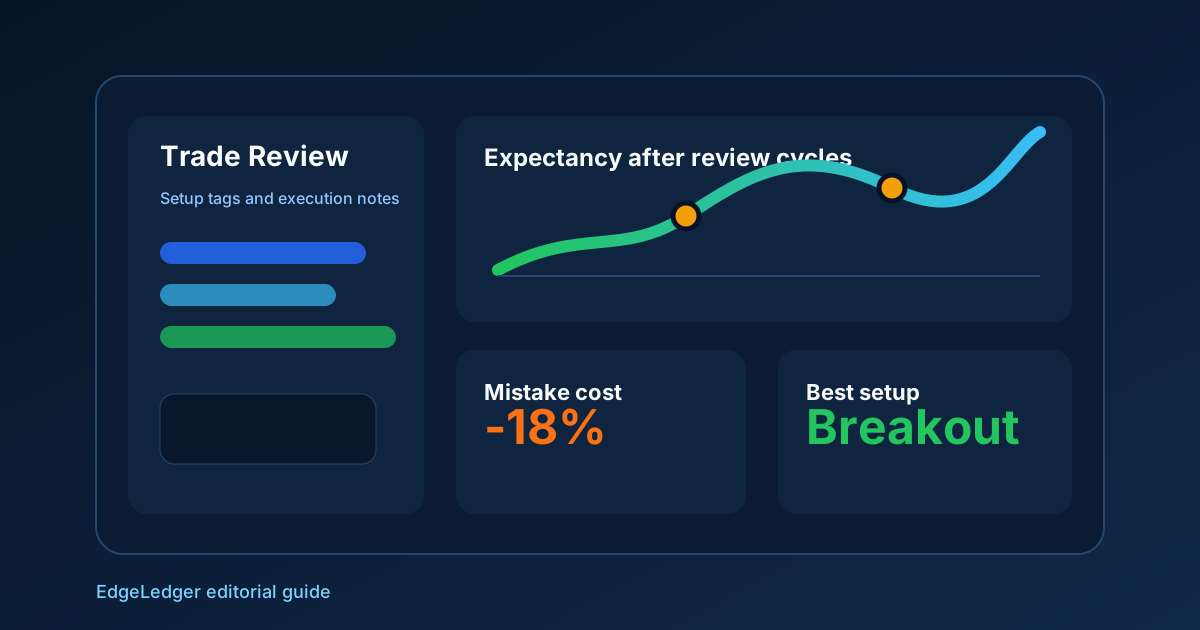
Tag each trade in your EdgeLedger journal with the order-book signal that triggered it — absorption, wall break, void, sweep, or none — and review the win rate per signal after thirty trades. The book signals that work for your instrument and your timeframe are not always the ones the textbooks emphasize.