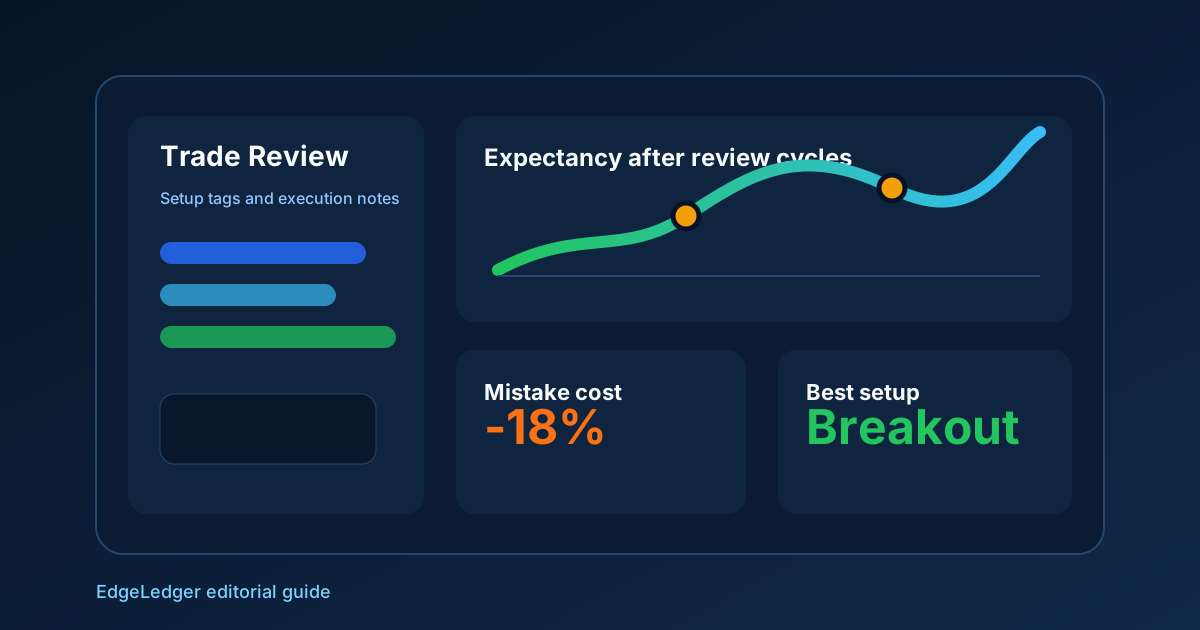
Profit Factor Explained: The One Number That Predicts Long-Term Trading Success
Win rate is easy to game. Profit factor is not. Discover why profit factor is the most reliable single metric to evaluate your trading strategy's long-term viability.
What Is Profit Factor?
Profit factor is the ratio of gross profit to gross loss across all trades. Formula: Profit Factor = Total Profit ÷ Total Loss
A profit factor of 1.0 means you're breakeven. Above 1.0 means you're profitable. Below 1.0 means you're losing money in aggregate, regardless of how many individual winning trades you have.
Why Profit Factor Beats Win Rate
Consider two traders over 100 trades:
- Trader A: 70% win rate, average win $80, average loss $200 → Profit Factor = (70×$80) ÷ (30×$200) = 5,600 ÷ 6,000 = 0.93 (losing!)
- Trader B: 40% win rate, average win $400, average loss $150 → Profit Factor = (40×$400) ÷ (60×$150) = 16,000 ÷ 9,000 = 1.78 (profitable)
Trader A wins 70% of their trades and still loses money. Trader B wins only 40% and is highly profitable. Profit factor captures the full picture; win rate doesn't.
Target Profit Factor by Strategy Type
- Scalping: 1.3–1.6 (high frequency, small edges)
- Day trading: 1.5–2.5
- Swing trading: 2.0–4.0
- Position trading: 2.5+ (fewer trades, higher expectations)
How to Improve Your Profit Factor
There are only two levers: increase average win size or decrease average loss size (or both).
- Let winners run: Trail your stop loss rather than taking fixed targets. One trade running 5R instead of 2R changes your entire month.
- Cut losers faster: If a trade hits your stop, exit immediately. "Letting it breathe" is an average-loss killer.
- Be more selective: Skipping low-conviction trades often improves profit factor dramatically by eliminating small, frequent losers.
Tracking Profit Factor in EdgeLedger
Your EdgeLedger analytics dashboard displays profit factor prominently alongside win rate and average R-multiple. You can filter profit factor by strategy tag, time period, or asset pair — allowing you to see which segments of your trading are generating your edge and which are dragging it down.
Sample Size and Statistical Confidence
A profit factor of 1.8 over twelve trades is not the same as a profit factor of 1.8 over six hundred trades. Below thirty trades the number is essentially noise — a single outsized winner or loser swings it dramatically. Confidence intervals tighten meaningfully past one hundred trades and become reliable past three hundred. Treat any profit factor based on fewer than fifty trades as a hypothesis to test, not a result to act on.
This matters for live strategy review. A new system that posts a 2.5 profit factor in its first month is more likely showing variance than edge. Hold sample-size discipline before scaling up size.
Profit Factor vs Sharpe and Other Metrics
Profit factor measures dollars made per dollar lost. It says nothing about consistency. A strategy with a 3.0 profit factor where 80% of the profit came from one trade is structurally fragile compared to a 1.6 profit factor with profit distributed evenly across many trades. Pair profit factor with the win rate, the standard deviation of trade R-multiples, and the largest single trade as a percentage of total profit. If the largest trade is more than 25% of total gross profit, your real edge is smaller than the headline number suggests.
When Profit Factor Decays
Profit factor rarely collapses overnight. It decays — a 2.1 number drifts to 1.7 to 1.4 over a quarter as market conditions shift or your discipline slips. Track it on a rolling thirty-day window. A persistent downward slope is a warning to revisit the strategy before the win rate or drawdown deteriorate visibly.
Per-Setup Profit Factor
An aggregate profit factor hides the texture. A trader running three setups might have a 1.9 overall while one setup runs at 2.6, another at 1.5, and a third at 0.9. The 0.9 setup is bleeding the edge from the other two — dropping it pushes the overall higher without changing anything else. Calculate profit factor per setup type, per session, and per pair. EdgeLedger's filtered analytics make this segmentation immediate.